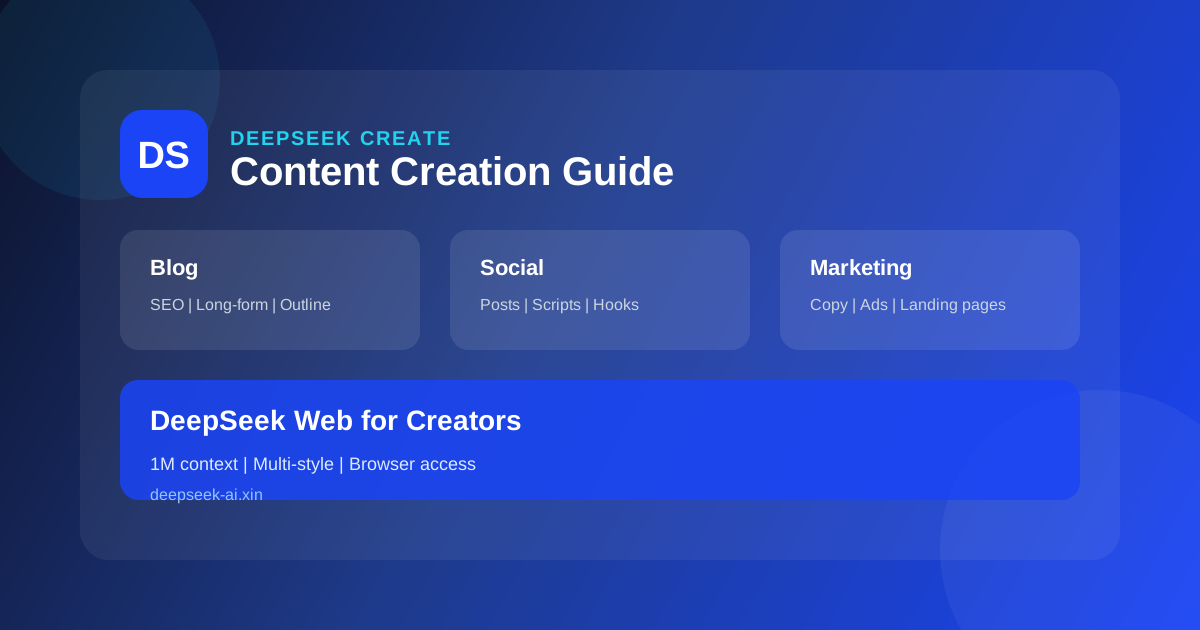
DeepSeek Content Creation Practical Guide: Produce Blogs, Social Media, and Marketing Copy Efficiently with DeepSeek Web
- DeepSeek
- DeepSeek Web
- Content Creation
- DeepSeek-V4
When creators search for DeepSeek, DeepSeek web version, or DeepSeek writing, they often want a reliable AI content creation method that consistently produces high-quality output—not just a few paragraphs of generic “AI-sounding” copy. Unlike tutorials focused on programming, office work, or learning, this article focuses on content creation in practice: how to use the DeepSeek web version to support SEO long-form articles, social media scripts, marketing copy, and multi-platform repurposing, turning DeepSeek-V4’s long context and multi-style expression into a reusable content creation engine. Whether you are a self-media blogger, marketing operator, or independent creator, you can start by opening DeepSeek web online chat in your browser and building an efficient, controllable AI content workflow.
Why Is DeepSeek Especially Well Suited for Content Creation?
The core needs of creators are: fast drafting, consistent style, balancing SEO with readability, and adapting one draft across multiple platforms. DeepSeek offers several standout advantages for content creation:
- 1 million token ultra-long context: Load entire competitor analyses, brand manuals, and historical article archives at once to keep series content consistent
- DeepSeek-V4 / V4-Pro dual models: Use the standard version for daily short copy; use Pro for in-depth industry long-form and logically rigorous white papers
- Three reasoning intensity levels: Fast mode for breaking news; deep mode for strategy-driven and argument-based content
- DeepSeek web version with zero installation: Edit drafts and test prompts in the browser anytime without switching complex toolchains
- Excellent Chinese and multilingual performance: Quickly generate bilingual versions of the same topic to support global content distribution
Compared to lightweight tools that “only write paragraphs,” DeepSeek is more like a creative partner that reads your brand materials, remembers your article series, and rewrites according to platform rules. Many teams first test topics and structures in the DeepSeek web version, then batch-produce and manually refine—this is a viable path that balances efficiency and quality.
DeepSeek Web Version: The Lightest Drafting Entry Point for Creators
Before integrating APIs or purchasing enterprise content suites, the DeepSeek web version is the best starting point for validating your content creation workflow. No plugins needed—open a browser to enter DeepSeek online chat, ideal for café editing, commute brainstorming, and rapid trending-topic updates.
Three Quick Steps to Get Started
To use DeepSeek web online for content creation, you typically need only:
- Open a browser: We recommend the latest versions of Chrome, Edge, Firefox, or Safari
- Go to the DeepSeek web entry point: Click “Try Now” on this site’s homepage to jump to the DeepSeek app chat page
- Describe your content task: Specify platform, audience, tone, word count, and keywords—DeepSeek will respond instantly
We recommend starting new conversations in the DeepSeek web version for different projects (e.g., Brand A WeChat account, Brand B Xiaohongshu), to avoid style confusion. Save frequently used prompt templates in your notes for easy reuse.
Device and Content Creation Environment Compatibility
The DeepSeek web version has low device requirements for creators:
| Item | Recommended Setup |
|---|---|
| Browser | Chrome 90+, Edge 90+, Firefox 88+, Safari 15+ |
| Network | Stable broadband; wired connection recommended when uploading long documents |
| Screen | Dual monitor: reference materials on the left, DeepSeek chat on the right for faster editing |
| System | Windows, macOS, Linux, iPad all supported |
When using DeepSeek web online in public environments, remember to close tabs to avoid leaking unpublished drafts and brand materials.
DeepSeek Content Creation Core Capabilities Explained
1. SEO Long-Form Articles and Blog Writing
Search traffic depends on clearly structured, naturally keyworded, information-dense long-form content. DeepSeek can help with:
- Generating article outlines (H2/H3 hierarchy) based on keywords and search intent
- Drafting 2,000–5,000 word in-depth tutorials, reviews, and comparison content
- Naturally integrating target keywords (such as DeepSeek, DeepSeek web version) in the body without keyword stuffing
- Generating meta descriptions, summaries, and internal link suggestions
Combined with 1 million token context, you can paste competitor TOP10 articles, official documentation, and your own past articles into the DeepSeek web version and request “differentiated angles while maintaining information completeness”—this is DeepSeek’s core SEO advantage over short-context tools.
Important reminder: Fact-check data and compliance language before publishing; AI-generated content should go through editorial review before going live.
2. Social Media Short-Form Content and Scripts
Short videos, image-text posts, and Threads require strong hooks and platform-specific tone. In the DeepSeek web version, you can request:
- Titles, 3-second opening hooks, and storyboard scripts following platform rules
- Rewriting the same topic as Weibo short posts, Xiaohongshu recommendation-style copy, or LinkedIn professional posts
- Generating 10 alternative titles for A/B testing
- Expanding frequently asked comment questions into FAQ short-video scripts
DeepSeek’s multi-turn dialogue lets you follow up with “make it more conversational,” “shorten to 280 characters,” or “add a call to action”—closer to actual publishing needs than single-shot generation.
3. Marketing Copy and Conversion Pages
B2B white papers, product landing pages, email sequences, and ad slogans each have format requirements. DeepSeek excels at:
- Writing conversion-oriented copy using frameworks like AIDA and PAS
- Generating multiple versions of slogans and subtitles from product benefit lists
- Translating technical specifications into user benefit statements
- Outputting email nurture sequences (subject line + body + CTA)
When creating marketing content in the DeepSeek web version, we recommend attaching a “brand tone guide” summary in your first message (formal/playful, forbidden words, target audience) to ensure consistent style across materials.
4. One Draft, Multiple Platform Repurposing
The same core idea must adapt to WeChat articles, Zhihu posts, Douyin voiceovers, Newsletters, and other formats. DeepSeek can:
- Compress a 3,000-word long article into a 500-word highlight post
- Expand spoken scripts into structured image-text content
- Keep core arguments unchanged while adjusting examples and tone
- Generate multilingual versions for global distribution channels
The original long-form content can be loaded into DeepSeek-V4 context at once to batch output multi-platform variants—significantly reducing repetitive “one source, many outputs” labor.
5. Topic Planning and Content Calendars
Consistent publishing requires a stable topic pool. DeepSeek can help with:
- Expanding long-tail topics and Q&A-style titles from industry keywords
- Analyzing competitor content gaps and suggesting differentiated angles
- Generating monthly/quarterly content calendars (theme, format, keywords)
- Quickly producing trend-jacking outlines combined with hot events
Maintain a “topic library conversation” in DeepSeek web online, adding new ideas weekly to build a searchable content asset.
DeepSeek Web Version vs. Traditional Content Tools
| Dimension | DeepSeek Web Version | General AI Writing | Professional CMS AI Plugins |
|---|---|---|---|
| Access | Browser-ready | Often requires App/subscription | Tied to specific platforms |
| Long-form & context | Up to 1 million tokens | Usually shorter | Depends on plugin |
| Style customization | Flexible prompts | Fixed templates | Limited |
| Multi-platform repurposing | Multi-turn in same conversation | Requires repeated copying | Mostly single-platform |
| Best for | Individuals and small teams validating quickly | Lightweight copy | Teams with chosen CMS |
Conclusion: If you need a flexible workflow “from topic planning to multi-platform repurposing,” the DeepSeek web version is a high-value starting point; mature teams can migrate validated workflows to the DeepSeek API for batch processing and automation.
DeepSeek Content Creation Practical Scenarios
Scenario 1: SEO Blog Matrix Batch Planning
Paste your core keyword list and competitor directory into the DeepSeek web version and request 20 differentiated topic ideas (including titles, H2 skeletons, and target keyword density suggestions). After manual screening, develop each article in depth to build a sustainably updatable blog matrix.
Scenario 2: Product Launch Full-Channel Materials
Input a one-page product brief and have DeepSeek output: press release, website FAQ, 3 social media posts, 1 customer email, and 1 sixty-second video script. Use multi-turn dialogue to unify terminology and benefit priority.
Scenario 3: Personal IP Article Series
Load your past 5 representative articles and ask DeepSeek to summarize your writing style (sentence patterns, common metaphors, structural preferences), then request “maintain this style” for new articles. Long context makes the series feel more cohesive as a personal brand.
Scenario 4: Global Bilingual Content Sync
After finalizing a Chinese long-form article, request an English version in the DeepSeek web version that is meaning-based rather than literal translation, with notes on expressions needing localization. Ideal for indie developers and cross-border brands reducing translation costs.
Scenario 5: Trend-Jacking Breaking News
When industry news breaks, quickly input event key points and brand stance boundaries—DeepSeek generates commentary drafts, short reviews, and community discussion prompts. Fast mode ensures timeliness; human final review ensures accurate positioning.
5 Tips to Boost DeepSeek Content Creation Efficiency
- Make your first message clear on “platform + audience + tone + word count + keywords”: For example, “2,000-word SEO tutorial for SMB owners, professional yet friendly tone, naturally mention DeepSeek web version 3–5 times”
- Outline first, then body: Ask DeepSeek to output H2/H3 and wait for your confirmation before expanding each section—reduces full rewrites
- Build a brand prompt library: Save templates validated in the DeepSeek web version to team documentation for consistent messaging
- Humans handle facts and tone: Data, citations, and compliance language must be manually verified; AI handles structure and first drafts
- Combine with site tutorials: See Complete Guide to DeepSeek Web Online for core capabilities; reference DeepSeek Workplace Productivity Guide for long-document processing approaches
Frequently Asked Questions
Will articles written with DeepSeek web version be flagged as low quality by search engines?
Search engines care about whether content is valuable to users, not whether AI was used. Content assisted by DeepSeek, then human-edited with accurate information and clear structure, is typically indexed normally. Avoid batch publishing unedited, homogeneous low-quality pages.
How long can SEO articles be with DeepSeek web version?
DeepSeek supports up to 1 million token context. Single articles of 5,000–8,000 words can have frameworks generated at once and be refined section by section; for longer content, use chapter-by-chapter conversations and final human editing.
Do I need deep reasoning for marketing copy creation?
Short slogans and social posts usually don’t require it. Industry white papers, competitor comparisons, and argument-driven soft articles benefit from deep reasoning mode in the DeepSeek web version for tighter logic.
How should content teams divide work between DeepSeek web version and DeepSeek API?
The DeepSeek web version suits editors and operators for instant editing and prompt iteration; the API suits batch generation of product descriptions, scheduled news summaries, and other pipeline scenarios. Many teams validate in the web version first, then scale with the API.
Related Reading
- Complete Guide to DeepSeek Web Online: Browser entry point and core features explained
- DeepSeek Workplace Productivity Guide: Long-document and report content processing
- DeepSeek Student Learning Practical Guide: Structured writing and knowledge organization approaches
- Complete DeepSeek Getting Started Guide: Master all DeepSeek features from scratch
DeepSeek is transforming AI from a “word-count filler” into a “collaborative content engine.” Open the DeepSeek web version and start with your next SEO long-form article, social media script, or marketing email draft—let DeepSeek-V4’s long context and multi-style expression help you create more efficiently and with greater control.
Validate on the related app site
Open this site’s related independent app (app.deepseek-ai.xin) to verify the approach above—or use DeepSeek’s official chat at chat.deepseek.com.